
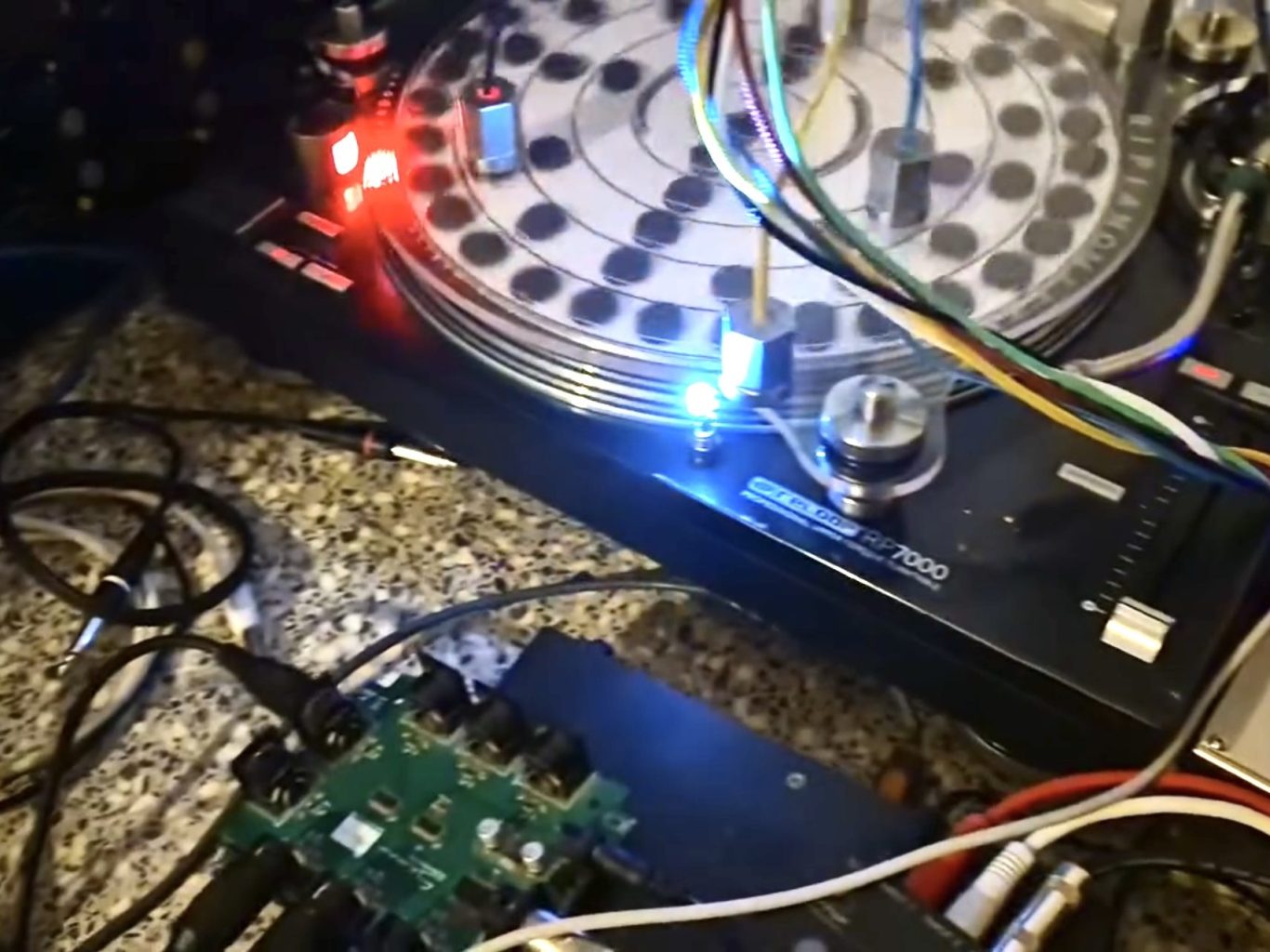
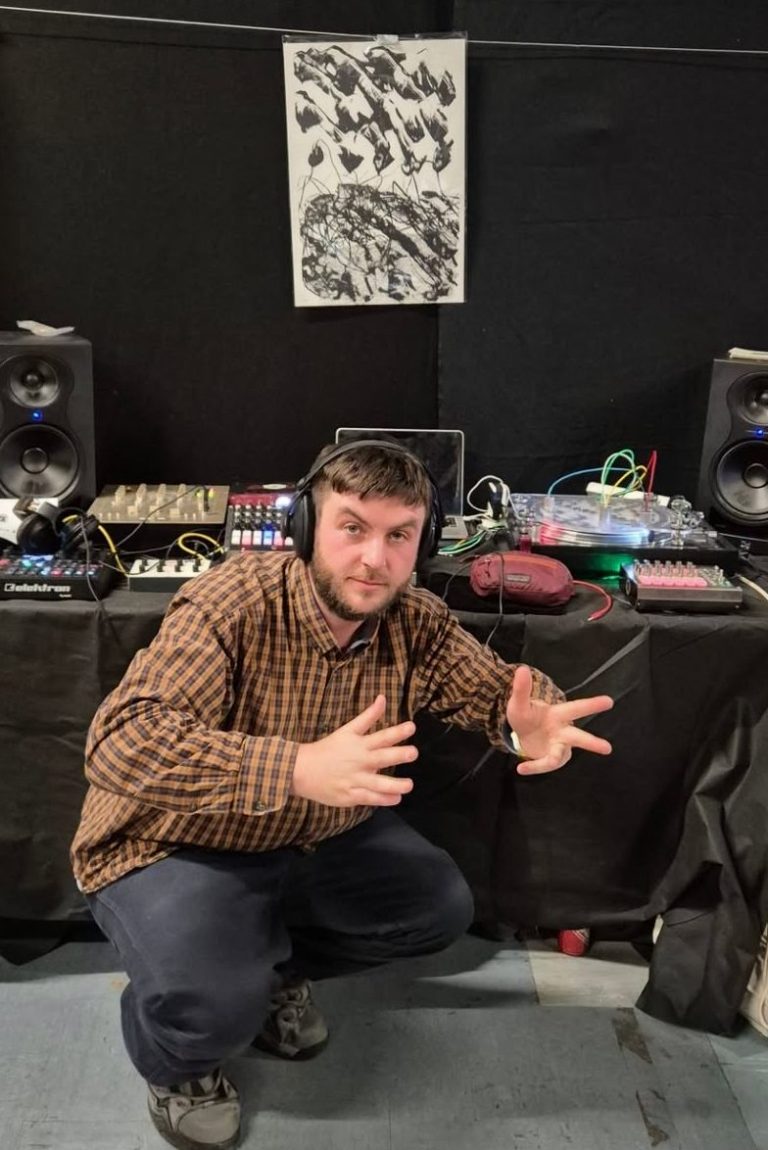
"..I think its important if you're playing live for it to be a bit scary, that can look like having machines blinking all crazy. "
This weekend, Bristol’s own Jackyboi takes the stage at Machina Bristronica, with his collaborative outfit. Known for his work with the Malista, a custom MIDI device powered by a spinning disk, Jackyboi treats hardware as both instrument and experiment. Earlier this year he released Malista Method 1 on NOIDED, a cassette that captures the machine’s strange rhythms and hypnotic textures.
Beyond the studio, he’s part of a driving force in Bristol’s underground, putting on raw, live techno nights that keep the city’s DIY pulse alive. We caught up with him ahead of Machina Bristronica to talk machines, methods, and harware use in live performance.
Let’s start with the Malista—what exactly is it, and how did you come to work with it?
J - Malista is a solution to many creative problems for me, it's a midi sequencer first and foremost the display is the interface itself, you read the positions of the pots, the metronomes, and the 12 RGB lights, to determine where you are, and where you want to go, in real time. The MiniMalista, is a way to feed the metronomes of Malista, this part is a steel 12" disc, that sits on a turntable, upon which magnets are arranged as a circular rythm. A perspex shelf is then placed over the turntable platter, which provides a surface for 6 electromagnetic sensors to sit above the spinning magnets, each time a magnet passes through the field of a sensor, a signal is sent to Malista. The master disk pattern of magnets follows the common metronome divisions, 1, 2, 4, 8, 16, 32, so a sensor placed directly above a lane will give a constant stream for you to attach midi events to. The magnets will never be placed in a perfectly quantized way, so for every revolution of the turntable there is a micro timing shift, depending on where you place your musical "1". Combining beat streams from the MiniMalista, and the internal 128(max)ppq beat streams from Malista, the user is able to potentially grab every and any beat within any bpm, while composing.
I found Giorgio, the man who made it, in a baraka in the Superbooth forest in Berlin, May 23. He was presenting M1, the first Midi capable iteration of the machine, it was the last night of the festival, and we hadn't been in that area too much. I put my hands on the machine, and it spoke to me, we synced up the turntable to the Euterpe display on the booth adjacent, and we played techno for a good 40 synth nerds. We exchanged details and to my surprise he asked me to be a part of the project, now we are on version M5, and the machine is a disgrace. Our daily toil and salvation. He is in Turin and me Bristol.
The spinning disk element of the Malista is pretty unusual. Can you explain how it interacts with MIDI and what sonic possibilities it opens up for you?
J - So there are 6 Mchannels and each of these can be routed, on a per beat basis to 7 ports (3 Midi DIN, 4 USB) each port also then has 16 midi channels of routing, so it's very easy to experiment quickly, if you have sound machines to plug it into. In our little studio we've got lots of synths to fiddle with, I just send midi all over the place from the wonky rythms provided by the turntable. But it also works really well at home in the laptop Ableton setup, using the internal rhythms. The fundamental point is that you play the settings, and you live record movements into the sequences, to develop little worlds.
Your NOIDED release, Malista Method 1, feels like part experiment, part ritual. Was there a specific process or philosophy guiding the recordings?
J - I basically quit my job because the old studio I ran with my mates from back home, developers had bought the lease and we were on a rolling months notice (a common story in Bristol) and I'd just got back from Turin in November 23 with my own fresh Malista unit, so I just decided to pretty much live in the studio getting to know how to pair it with sounds. Lots and lots of experiments, and probably not spending more than 6 hours on track, sometimes even like 20 minutes, but yeah we ended up losing the studio properly in August 24 and I had stacks of audio.
I do like the tracks that are uplifting though, which is part of the ritual surely. That time was pretty sacred in the machine developing, Giorgio responded every day with code updates from user interface requests from testing, it ironed out loads of bugs and new concepts appeared from the beat mining.
Do you treat the Malista more like an instrument, a tool, or a collaborator when you're creating music?
J - I think to be honest it can be all three. A collaborator could be when you set it up to do something where you don't have a pre determined musical idea in mind, it's fun to see, but also a job to try! I play it like an instrument when I've got a bunch of sounds I'm happy with, and I use it as a tool on other people's productions, and for playing visuals and lights!
You’re based in Bristol, a city with a deep electronic music legacy. How has that environment shaped your sound and your approach to performance?
J - Its greatly improved the low end. It's just so good that everyone's up for anything as well.
You also throw your own live techno nights. What drives you to put on events, and how do you curate them to stand apart in a crowded scene?
J - Well it's a big collaboration and the Malista is a very good midi clock, people bring their sounds and machines and we mix them in on a 24 channel mixer into a Dj mixer, all synced and free flowing. The turntable pitch control is a very nice way to increase or decrease tempo steadily, and people come and throw their sounds at the very very decent system at The Love Inn.
It's been great to hear people bouncing off of each other, and we've had a few people fairly new to live performance come along and smash it, which I'm very much in support of. It's very visually pleasing seeing like 8 people all locked into a big groove, with their lights all flashing.
Do you bring the Malista into your live sets? If so, what’s the audience reaction like when they see it in action?
J - I actually think that since I got it, I haven't played live without it, sometimes without the MiniMalista turntable part, but yeah it drives Cracked Beat Social Club, which is my live project with my pal Mario.
The best part about it is hearing people explain to their mates what's going on when they realise the magnets are generating the beat. A couple of times early on the bass rattled the sensors around on the shelf and I lost beats in real time, and the people always know instantly because the groove shifts and theyre in the turmoil with you, it's weird, we say it's driving the beatbus.
How do you balance the unpredictability or physical quirks of hardware like the Malista with the structured demands of techno?
J - It's definitely a preference thing, and i think personally I'm drawn to techno that isn't very structured, dubby shifting sounds, playing the soundsystem, dj's that really mess with your perception of music are my favourite to experience. Ivokovic, Powder, Batu and Nobu seem to do this I think, and they play techno parties all the time, so I try and play Malista in this way if there is an audience that want to dance, build weird rhythms and move around the soundscapes.
What’s your relationship with physical hardware, synths, live rigs etc? Why do you think these tactile formats still matter?
J - I come from playing in bands, so I like seeing the interaction between musicians, but most of the time these days it's not viable to be in a band, so I guess the hardware should give the interaction aspect, if you're watching someone play machines. Sarah Sommers makes everything pink! It's amazing! So yeah I think its important if you're playing live for it to be a bit scary, that can look like having machines blinking all crazy.
Finally, what's next for you and the Malista? Any future releases, events, or projects we should keep an eye on?
J - Machina Bristronica should bring good tidings! Other than that, Giorgio is currently building a studio at his place in Turin, so maybe some kind of 'Advanced Malista Methods' album may appear soon!
Listen to the Malista in Action here