
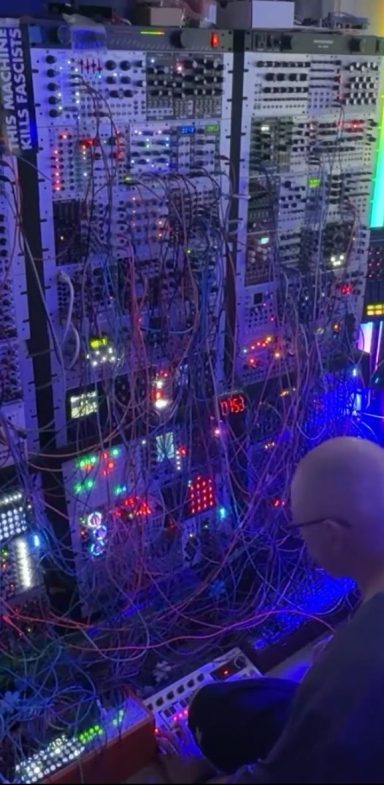
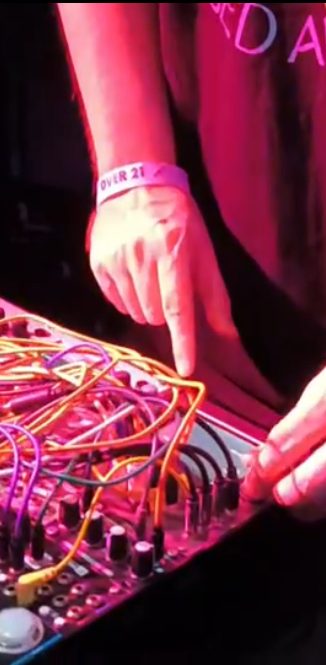
I'm rather fascinated seeing a giant mess of patch cables come to life spewing sounds. I suppose the question becomes "Can I harness these sounds to express my intent?"
Renku Corporation
Renku Corporation operates deep in the circuitry, not just of modular synthesis, but of sonic process itself. Hailing from Houston, his sprawling catalog of live-recorded modular compositions exists entirely outside the DAW-dominated grid, preferring the messy logic of feedback, voltage, and pure signal flow.
With Procedural Nuance, released on CD via NOIDED, we glimpse a refined layer in the organism: sharp-edged, recursive, yet full of buried warmth.
How did Renku Corporation come to life? What sparked your move toward modular synthesis and live hardware-based composition?
Renku Corporation was started in 2002 after my industrial band Subrealm broke up, as an outlet for techno and IDM. I played guitar and keyboard while my bandmate played keyboards and ran the drum machine. I did my first solo project using his keyboard sequenced with my Compaq computer. I started building a small studio and wanted a new name for the new tracks I was making.
Modular came much later. I had a single row of Frac Rack, a 3.5mm 3U modular format popularized by Blacet. That was all for some years.Being a guitarist, I started to get really into boutique pedals. One of my favorites, the WMD Geiger Counter, became available as a modulein the Eurorack format. I was really excited for the possibilities of controlling and sequencing/modulating the parameters so I said "just one row" and entered the arena that is modular. One row quickly led to two led to more and now I have about 4000hp of modular.
I actually struggled for several years to be productive with it and make listenable music. Learning how to control the beast took time, I suppose like learning any instrument. I credit the Nord Modular synths for helping me understand most of the concepts from their great manual and the editor. Around 2017 I started to really focus on modular exclusively and had put away most of my other gear.
Was there a moment or album early on that shaped your aesthetic or approach to sound?
I remember bringing home the "Richard D. James" album and putting it on my boombox and 15yo me was simply blown away by the opening track "4". I hadn't heard anything remotely like that before and I was absolutely hooked. From there, episodes of MTV's AMP'ed showcased tracks like "Second Bad Vibel" by Autechre and fuelled more exploration. It was then that I knew I wanted to use synthetic sounds, new timbres that did not resemble any worldly instruments.
The name “Renku Corporation” evokes something conceptual or cybernetic. What does it represent to you, and how does it reflect your music?
The story behind the name Renku is kind of funny. As a kid I was really into the Sega Genesis version of the game Shadowrun. It's set in a future world sort of like Neuromancer. Deckers (hackers), samurai (fighters), mages. It was an open world game with nonlinear gameplay. In the game world, corporations have become mega powerful and largely own the government. One of the corporations in the game was called Renraku and their Strike Team would constantly pop out of nowhere and attack you once you got too close to the truth. I mistakenly read it as 'Renku' which I learned is a Japanese form of poetry (similar to a Haiku). I liked the sound of it and the sort of preposterous idea that a 'corporation' might be able to make any type of meaningful art. Thus the moniker was born.
Can you walk us through a typical session, from patching to final recording? Do you leave room for improvisation or is each piece carefully designed beforehand?
Sure, usually the session starts with the modular completely unpatched, I almost always start from scratch. Typically I will have a kernel of an idea or desire. Perhaps I want to work with a given module or pairing or a certain style that I want to aim for. It starts with trying to patch that first idea and then build on it with subsequent parts. Sometimes I will start with drums, other times I start with chromatic parts. Each part I route through modules that allow me to mute/unmute 24 channels. When I feel like the suite of parts is complete, it becomes time to 'perform' the patch and record it. I essentially 'compose' the track on the fly with the mutes and reach around the system to twist knobs and such, recording everything to multitrack. I may do some minor editing and then mix down all the parts on an analogue console.
Do you use any sort of notation or system to keep track of your patches and signal flows? Or is each piece ephemeral once recorded?
Yes, I use a pad of graph paper. I have a system of notation based on the mute channels, I will write the numbers 1 to 12 across the centre of the page, representing 2 rows of 12 buttons that are the 24 mutes. Above or below each I will write the chain of modules connected to that mute. However this notation is not comprehensive enough to recreate the patch; that level of documentation would be too cumbersome. The documentation largely serves as a guide while working on the piece, often thrown away a week or two after the recording. In that way each piece is indeed ephemeral. Once the modular is powered off, the state of the patch is lost. I typically work with the modular powered on for several days straight to preserve state.
What’s the balance for you between technical mastery and intuitive play when working with modular gear?
I don't like having to remember strange representations like button combo presses or what different colours on an LED mean. The system is large enough to make mastery of a complex module somewhat elusive, therefore a premium is placed on modules with clear, WYSIWYG functionality over more functional density. I pride myself on the ability to figure things out with minimal consultation of the manuals. Intuitive modules help that a lot.
How did Procedural Nuance come together? Was there a specific concept or framework you were exploring on this release?
The album was composed over 2024 exploring the idea of machine-based music as a medium of expression and communication, a recurring theme for me. As such, there are no acoustic or electrified instruments; most of the sounds originate from the modular. I'm rather fascinated seeing a giant mess of patch cables come to life spewing sounds. I suppose the question becomes "Can I harness these sounds to express my intent?" Also, I wanted to make all the tracks somewhat beat-oriented. I wanted people to be able to tap their feet or nod their head.
The album title suggests algorithmic or rule-based creativity. Are generative systems part of your process?
While I occasionally use generative methods, they were not used much on this album. Here 'procedural' is a reference to the process of incrementally building a patch from parts, and part from individual modules. The aspect of 'nuance' is the ability to control these parts such that a coherent musical expression can arise. The album title is meant to suggest subtlety and depth can exist in these machine-driven processes.
What role does failure or unpredictability play in your practice?
I've always been a fan of John Cage and his stochastic processes in composition, but I struggle to harness these processes myself. Cage didn't like hearing things the same way twice. For example, he never specifically notated how a piano should be prepared. Without a prescriptive solution, each preparation of a piano is very likely to be unique, thus making each performance different. While that was great for Cage, for my own works I generally like things to be deterministic and consistent. I tend to use random/stochastics in small doses.
As for failure, I think any musician/composer is going to be quite familiar with that. My hit rate is better these days than maybe it was but I still have plenty of abortive sessions that don't lead to anything. Worse are the sessions you think are good at the time, only to look back a week later and wonder why, disappointed and frustrated. Failure is part of the game and as such it should be accepted and embraced. Each failure is another step towards that ultimate but unrealisable goal. Each success is the product of the failures that came before, informing the production of the next piece.
Looking ahead, are there directions you're excited to explore? New modules, formats, or collaborations on the horizon?
There's always something cool like a new module or a new synth coming out. You can never catch them all. I try to be selective about what gear I use and avoid significant overlap. I try to sell things when they aren't working out for me. I've got a number of grooveboxes/modules/pedals that I haven't dived into yet, so that's exciting territory. I'm also interested in doing more visual work, tightly integrated with the music.
I have a number of tracks stacked up from this year that are unreleased. My goal is to keep building stylistically similar works and package them up as a new release, probably to come out on Thanksgiving. I have released four albums in previous years on this day, so the next release will be "Giving Thanks 5". It will feature some of my works with electric and acoustic instruments (guitar, saxophone, dobro) alongside modular and synths.
////
Procedural Nuance is available Out now on CD + digital download.