
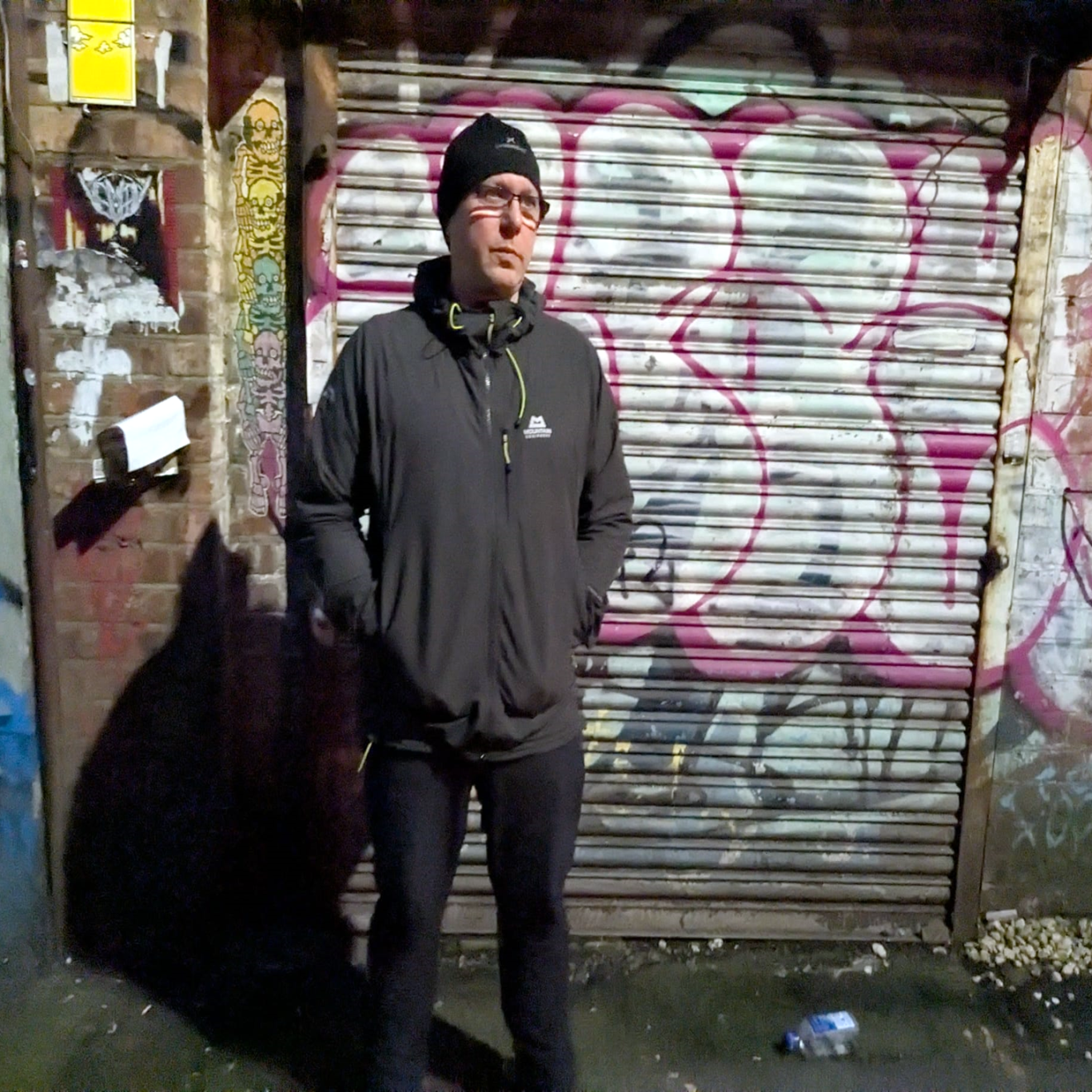
These days, I don’t have to keep reinventing the wheel as I have built almost all the tools that I need to manifest these shapes and functions..
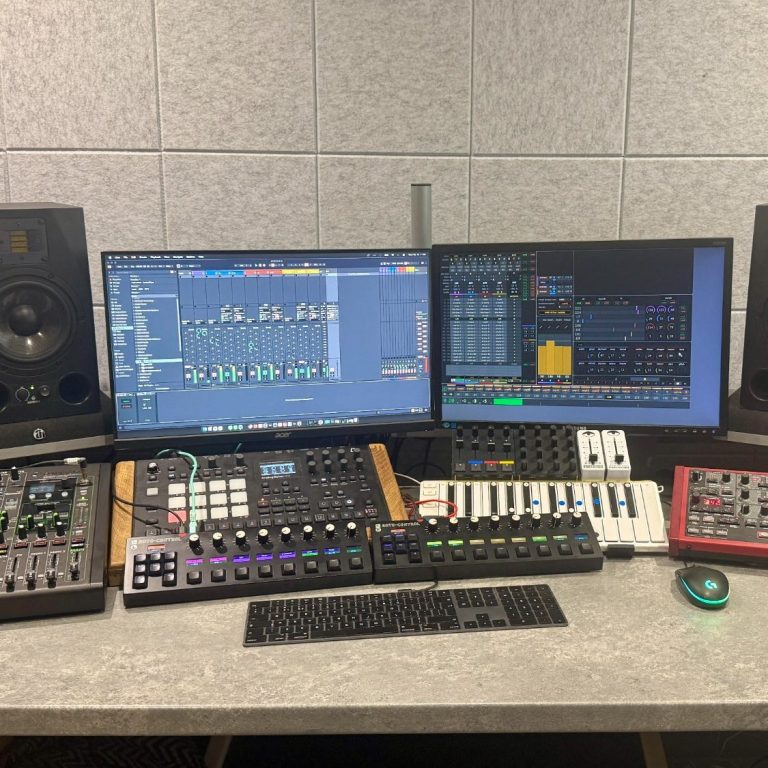
Scott Hanley AKA TRAUMM makes complex and deep IDM worked from a mix of hardware and custom softwares. With a superb release on NOIDED and some live shows upcoming, Scott sat down for a chat about his processes and collaboration.
For people discovering your work for the first time, how would you describe the musical world of
Traumm?
Hi Ant and thanks for the support. I guess the sound, I’m trying to achieve as Traumm could be summed up as
a delicate blend of colour and energy that attempts to feel equally both human and mechanical in its
construction. The humanness is the relatable self-reflective emotive element, and the mechanical is the
autonomy of systems and mechanics that I heard when working in factories many years ago. I’m hoping
listeners can hear this in the timings, sequences and frequencies of my work.
I love the rigidity of metric-based timings and the stark, and sometimes abrasive, nature of mechanics. When
this is married with the more melodic and emotive human elements, it becomes a true reflection of our world.
However, it’s a never-ending work in progress because I am my own worst critic, as many musicians are.
Your music often feels as though it's generated from systems rather than traditional songwriting.
How much of your work begins with an idea, and how much emerges through experimentation?
Initial ideas come to me in shapes and colour, or the way certain frequencies might work together. There’s
something about the symmetry of these shapes that grabs me and I try to develop as I translate them to
sound. The symmetry allows these shapes to work together.
I might ‘hear’ a low frequency pattern, in my mind, and an accompanying higher frequency element, that
dances around it or compliments it in some way. The shapes are usually made up of two elements. Then I’ll
manifest the lower frequencies first – with an appropriate sound source. Maybe that’s because I was a bassist
in a past life, I don’t know. Then I’ll work on its counterpart until I have it working together as I want it.
Sometimes I can write a long-detailed piece for a particular frequency or timing before even working on
another sound. It really depends on the initial shape idea. The rest of the piece is built up around that with
various tools.
You work extensively with Max/MSP. What first drew you to that environment, and what keeps you
coming back to it? Max/MSP has long been used by experimental electronic artists as a platform
for building custom instruments and generative systems.
To be honest, I use a bespoke M4L system for performance and full fat max in the studio for developing
particular tools and functions. It’s an easy setup, but I plan to migrate to full max for performance once I’ve
developed a good enough audio-rate sequencer, and other abstractions that I need.
Ableton is great at what it does, although not an entirely stable platform, but has the bonus of the M4L API
integration for accessing the LOM. To tackle Live’s instability, I’ve recently switched to an RME interface,
which also adds low latency and DSP. But the way Ableton handles data threads is not the most efficient.
Ableton, for me, didn’t quite have the functionality that I was after. I wanted to be able to ramp clock divisions
based on tempo ranges or have snare decay react to how many snares were currently being triggered in that
moment, and things like that. So, like if a rachet value, of a percussive element, was greater than zero, then
decay drops to 20% of its capacity. That sort of thing. I have built an extensive library of abstractions now that
saves me so much coding time on new projects. I just cannot get the controllable detail in Ableton alone that I
want without max, unless I spend hours on automation, but that takes away some of the mechanicalness of
the thing. Also, for live performances, you kind of want as much realtime control as you can get without being
chained to a linear timeline of events
Do you build your own tools and patches from scratch, or has your setup evolved gradually over
years of additions and modifications?
I use a combination of plugs and max tools really. My system is all in the software domain now, which speeds
up the workflow for me. I just wasn’t getting the results anymore with my beloved Elektron boxes. As brilliant
as they are, they just have too many limitations like; not being able to swap out a sound without changing the
whole kit. Yes, there are always workarounds with Elektrons, but some limitations can just slow down your
workflow too much. Also, the onboard sequencers weren’t quite able to produce the more fluid ‘feel’ that I was
after. I did try to completely control them from max, so that the box becomes only a sound source, but I had to
fight it to pull out what I needed, and it just wasn’t flowing for me.
Plugs are great for the way they specialise in certain functions. Like the Pultec EQ trio for adding flavour that
just can’t be replicated elsewhere for example. But some things that involve timing or ramping are mostly
produced by max abstractions and devices that I’ve created. On some of my projects, I may add more
functionality to say the clock div or incdec abstractions, as I go, but connecting them to achieve certain
outcomes is the fun part. Sometimes I’ll create a simple midi clip in Ableton, just to get the idea down, then
rebuild it in M4L or max to be able to morph its parameters or something. I have built enough tools now to
work on any idea really. It’s taken a few years to get to that, but it was worth the investment of time and
learning.
When creating a new piece, are you designing a composition, designing a system, or some
combination of the two?
It starts with the initial idea of a shape, in my mind, which might mean building a percussive element that
needs to morph in a certain way. That’s one angle of the “shape” part of the idea. If I don’t have the tools
already to produce that then I’ll use max or M4L. These days, I don’t have to keep reinventing the wheel as I
have built almost all the tools that I need to manifest these shapes and functions, but yeah, there’s always an
element of building a device or something for a project.
If it’s for performance, then that restricts things somewhat, as the elements need to be macro’d up and then
mapped to controllers to be playable in certain ways. But in the studio, I can experiment more with
automation. It’s a very time-consuming process but the tools I’ve built help me to keep focused on the current
idea/project.
Many artists spend years searching for a unique sound. Has building your own software
environment helped you develop a stronger artistic identity than using off-the-shelf instruments?
Yes definitely! If you have a strong idea of what it is that you want your sound to be sound like, and it’s not just
regurgitated Roland sounds, then you have to put the work in and develop the tools to do it. Off-the-shelf
devices and presets just don’t get there for me. All presets are built from the initial state and all sequencing is
my own.
My sound is a culmination of all my favourite moments in all the music I’ve enjoyed over the years, and it’s not
just electronic artists. I’ve included a list of tracks that made a big impression on me at the end. I was a
bassist in my past life so love lower frequencies, and something like the bassline in the Girlschool song (When
Your Blood Runs Cold) has a change from E2 to Eb2 to E3 (Chorus part) which is just sweet. It’s a stark and
rude bass note that cuts in briefly and grabs you. Or the timing in the organ solo part of Led Zeppelin’s – No
Quarter (live, 1973) is just so nice.
It’s weird but most of the character of my electronic sound has come from the influence of older bands and
artists. I’ve cherrypicked all the little changes and phrases etc and stored their essence for later use in my
own modern electronic music interpretation.
All these elements have given me clear direction of what I want from my sound, and off-the-shelf tools just
don’t get me there. I have some Darkglass pedals too, that I want to somehow make use of in the future,
which would satisfy my dirty bass tone preference. I think it’s important, especially now, to not let off-the-shelf
gear define you and learning them thoroughly helps you break away from everything else.
Are there particular artists, composers, coders, or sound designers who have influenced your
approach to electronic music?
Oh most definitely, and the main and obvious one for me, since discovering them in 1996, is Autechre. I feel
they are always ahead of the rest of us and not bound by the constraints of genres. I think that’s the ultimate
goal – not to be pigeon-holed, and their approach to using fewer devices but learning them well absolutely
resonates with me. To be honest, a lot of my influence goes back many years to bands like Soft Machine and
King Crimson, and the effect punk had on me in the late 70’s, when I first came to England. Trying to
encapsulate that essence in electronic music is, I find, a really enjoyable pursuit.
I loved how the setup of the early days of Tangerine Dream was, with modular systems and a live drummer
and bassist. Or the non-traditional setup of The Velveteers coupled with good song writing. Pushing the
boundaries, if done right, can pierce the retro bullshit filter with raw honesty and that’s powerful and emotive.
The tune part of Autechre’s – Rae has me almost in tears every single time. It’s even more emotive than
Beethoven’s – Moonlight Sonata for me.
How do you balance control and unpredictability in your work? Do you enjoy being surprised by
your systems, or do you prefer to guide them toward a specific outcome?
I don’t really have much unpredictability in my work anymore. I have a clear goal and work towards it so it’s
not a surprise to hear the result. I think, when you first start out, devices presets can woo you very easily but
as you get a stronger sense of what the device can actually do it opens up the world of control and intent, so
you start using the initialised default and shape it from the ground up. Those harmonic artifacts and details are
exactly what I’m trying to bring out, but in a very controlled way.
I think that previously I loved devices and software surprising me with little gems of sounds or sequences etc,
but as you get to know your system(s) well, the surprise is less often and gives way to something more
intentional and unique to you.
So do accidents play any role in your creative process? Have any of your favourite pieces come
from something "going wrong"?
Again, happy accidents are few and far between for me now as I know what it is I’m trying to achieve. They
were a thing in the early days, when I was learning my gear, but everything is intent now. The only things that
might surprise me is when I have a synth line, that is being meticulously controlled, and I change it’s source
waveform. That changes the harmonics completely and can give nice results, but can also kill some other
harmonic content, so I have to approach it with full intent really.
Your collaboration with MODUL as AXON takes a different form from your solo work. How does the
creative process change when another person is involved?
Axon has become the culmination of Traumm and MODUL now really, as we currently don’t know any other
artists that would/could be a part of it at this stage. That may well change as we get to know more artists.
The tools and creative processes are the same for me in Axon, but I’m working to some loose predefined
rules. I think it’s pretty much the same with Anthony in that respect too. In Axon, we both decide what role
we’re playing in the project first. So, like our current live projects (2026) is me doing the percussive elements
and Anthony (MODUL) performing the more melodic parts. We pick a key and scale, go off and write our parts
completely independently of each other, then see what works and doesn’t work at rehearsal time. Next year
we have plans to switch roles and work on studio material. We have also talked about us splitting the
elements in alternative ways, so like one of us doing kick and bass while the other does snare and synth –
that kind of thing. That would produce some very different rhythms and textures. It’s a very free partnership,
and we’re both quite empathic so it’s not hard to agree things.
When working as AXON, do you divide responsibilities, or does the music emerge through a more
fluid exchange of ideas and material?
Yes, that’s exactly it. We decide beforehand who will be doing what then go off and create our parts
separately. With live projects its pretty much the same. We create our parts, rehearse them and improve
where needed before booking any gigs. We have no say on what gear or system(s) the other is using. That’s
what gives us the best results I think. It’s a very free collaboration that works well in both performances and in
the studio.
Do you approach sound design differently for AXON than you do for Traumm, or do the two
projects share the same sonic DNA?
Personally, I use the same methods, for building Axon material, as I do Traumm material, I couldn’t really say
in depth how Anthony approaches Axon material as our tools are quite different and ever evolving and
changing.
I omit/disable the tune or percussive functionality, in my system, depending on our current project. My
performance system is very versatile, and I can just swap out elements/sound sources etc to suite. As far as
studio tracks are concerned, it’s relatively similar to my approach as Traumm, but I’m working more to ‘fit’ what
works with Anthony’s stem(s). It’s more purposely created to go with what the track needs. For Traumm work I
can experiment with pedals for hours if I want as there isn’t quite the same goal. But honestly, both my work
for Traumm and Axon work is pretty similar in that respect. I think it’s the same for Anthony too, but he would
be able to elaborate that better than I.
Technology changes rapidly, but many artists eventually settle into a core set of tools. Is Max/MSP
still opening new creative doors for you, or have you reached a point where the limitations are
more interesting than the possibilities?
Yeah, it’s been such a long journey of buying and selling hardware to arrive at the right tools that I need for my
workflow. I don’t like to have too many devices as it becomes a hindrance rather than a help. If you pick the
right tools, that you can learn to do everything you need on them, then why complicate that?!
I used to have Nords, Elektrons, E-MU, Access, Waldorf, Lexicon boxes but for me, having everything now in
the digital domain speeded up my workflow and allowed me to fine tune it. I have such a lot of software now
that can do anything I need, and I also have the right controllers to manipulate it. Max is the bridge that lets
me connect things in predefined ways and is only limited to the ideas I have. It’s not really that Max surprises
me but more the ways in which it allows me to create intelligent connections between parameters and
hardware over time that surprises me, if that makes sense?!
It does. So looking back at your earlier work, what aspects of your music have remained constant, and what
has changed the most?
I think the main constant, for me, would be not conforming to this or that genre. I have zero desire to be
traditional in anything. Evolution needs the ability to breathe. I’m not in this for fame or anything other than the
need to create and express. Also, I still love energy in my music.
One thing that has changed is my ability to conceptualise those initial “shapes” and ideas into something
interesting. With the edition of more intelligent tools my music is sounding less contrived. That’s intentional
too. I’ve been aware of my music sounding over contrived for a long time and am always trying to eradicate
that with increasing success, I think. The goal was always the same, in trying to create something different,
but tools very much have. It’s really gone from hardware sound sources to software. And that goes for most of
the tools too. I still don’t like vocals in my electronic music but would into creating something for a good
rapper.
What are you currently exploring that listeners might not expect from your next release?
I’m trying to move my ideas into a more tune-based sound and away from glitch. Glitch is nice but has a short
shelf life, but tune elements, done the right way, can have better longevity. I also want to explore the dynamics
of hard and soft elements/sections more, as it’s still not currently my strong point. I remember one of my 90’s
band’s drummers saying, “we need more dynamics in our sound”, and that kinda stuck with me. After that I
kept hearing dynamics in so many tracks. That hot and cold difference, of changes in tempo or velocity within
sections. I think it’s more relevant to studio tracks than live sets perhaps – where you need to keep up a
certain energy level for longer periods. DJs may disagree with me there with their crazy hand gestures
[laughs].
I will be working on album tracks as soon as my new performance system is finished, which I’ll be using in
upcoming gigs for 2026 and beyond. I have many new ideas I want to explore and can’t wait to get started on
that.
Listen and purchase Col Occula by TRAUMM here
TRAUMM live in 2026:
- Thu 20 Aug - Traumm at Golden Lion (Lancaster)
- Tue 1 Sep - Traumm at Golden Lion (Todmorden)
- Thu 17 Dec - Axon at Golden Lion (Lancaster)